Placeables
Working on the AI-driven narrative portion of the game can be very swingy - sometimes I’m sure I’m on the bleeding edge of gameplay, and sometimes I feel like the whole thing is a trash fire that should be ripped out completely. When the latter reaction comes up, I find it best to shift gears and refocus on the discrete moment-to-moment gameplay: explore the wilderness, fight monsters, gain treasure, level up.
As much as I am fascinated by AI-generated narrative and its potential for realtime gameplay — it’s the very reason this project exists — I remind myself that it’s not the only thing this game is about. The narrative is a value-add, it ties the experience together. But the simple loop of exploring the map and getting into combats must be fun in its own right as well, otherwise players will drop out before the novelty of the narrative content ever registers.
Inspiration
A big inspiration for the combat system in Hexcrawl is the game Card Hunter. This game is a personal favorite - I’ve been playing it consistently since it was a web-based flash game. These days you can find it on Steam, and the number of hours I’ve put into the thing is more than I care to admit.
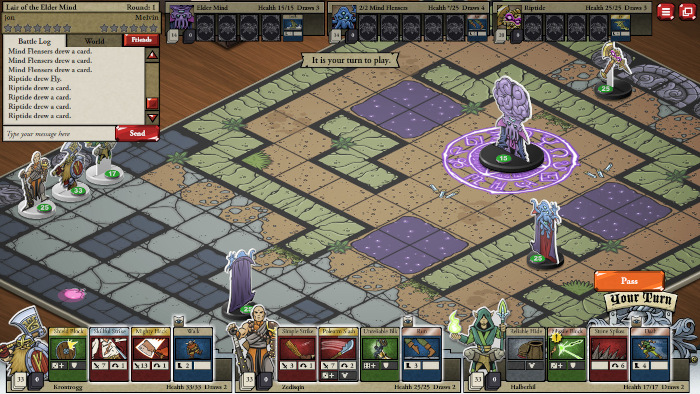
The deck builder aspect and the art style are both endearing to me, but ultimately not pertinent here. Those elements aside, it’s a very solid little 2D battle map skirmish game. The tactics have just the right amount of variability to keep me engaged, and it feels very much like a classic D&D style combat playing out on a battle grid.
When I need a little break from game-making, this game is absolutely my go-to. When I’m playing it, I can’t help but analyze what pieces of it I haven’t yet mirrored in the combat system of Hexcrawl.
The Decision to Go Grid
Other inspirations for Hexcrawl - games like Barbarian Prince or Sorcery! - don’t include grid-based combat. They simplify combat by eliminating position as a concept. You can see similar approaches in games like Final Fantasy or Darkest Dungeon. I think this is a totally reasonable choice, and it helps keep the combat streamlined and out of the way when it’s not the real focus of the gameplay. It’s exactly what I did for Road of Kings.
However, early on when designing Hexcrawl I chose specifically not to follow this model and instead do a full 2D grid with movement as a component. I realized that when playing Barbarian Prince, combat was the first thing I wanted to automate. While I like combat existing and maybe even want a dramatic account of what happened, I hate getting bogged down in dice rolls with very little decision making. I wanted combat in Hexcrawl to be more engaging, and Card Hunter was right there as an example of a game that I found so engaging I’ve continued playing it for years.
Placeables
That brings us to the newest addition to the combat system, following on from consumables: placeables. These are things that can be placed on the grid that last for a set duration and change the nature of the battle map. Think of things like caltrops, smoke screens, walls of fire or ice, etc. They may cause damage, block line of sight, or block movement completely.
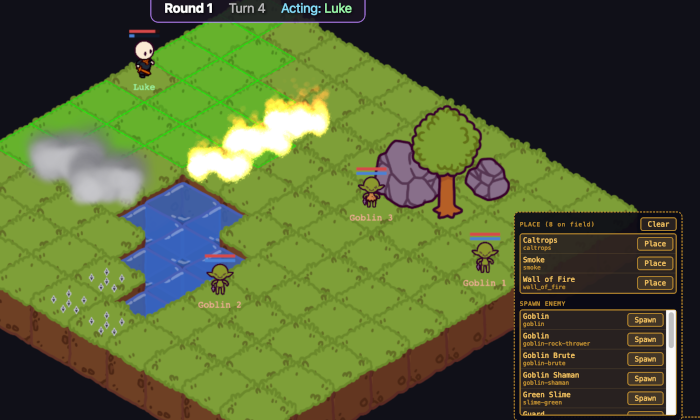
It’s still a work in progress - I need to wrap the placeables in items and abilities. A “wall of fire” spell is in the works, as well as caltrops and smoke bombs as consumable items. Also, I need to teach the combat AI how to deal with all this, both to prefer avoiding standing in damaging spaces and how to use abilities that create them effectively.
Working on this feature also took me down a side exploration of particles. Fire and smoke are natural use cases for particle systems, and I discovered my particles were using the older file format for particles. This is because all the third party tools I could find for making particles in Phaser are written against this older system. The full Phaser Editor is the only tool I could find for editing the new style of particles.
Particle Editor
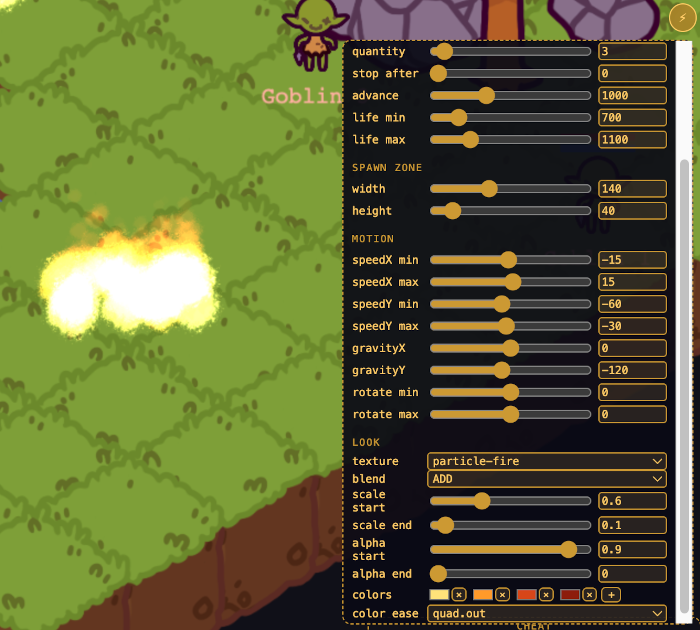
So I set my code agent to task in making me a tool. The interesting thing it landed on was integrating it right into the game – run the game, open the cheats, and you get a full particle editor. The nice thing about this is you get the particles rendered right in the actual game, meaning there’s no visual translation of what it looks like in tool vs in game. What you see is truly what you get.
I honestly think this is one of the real boons of AI-generated code. I’m uneasy about shipping products with code I haven’t at least reviewed, but for a one-off bespoke tool like this, I don’t mind a little vibe-coding. I’m the only consumer of this code, and if it does what I need, who cares if the code is awful?
I wonder if we won’t see a shift in how games are made now that this kind of thing is possible. Do we really still need giant multi-use swiss army knife style tools to create game assets? One of the biggest problems with huge asset editors is that they’re made for no specific game. They’re either lacking that one feature you really need, or they have so many features it takes forever to learn how to use the tool.
My particle editor doesn’t have either problem, because it was built for one game and one user: me. It has exactly the controls Hexcrawl’s particles need and nothing else. I could see more tools going that way - artists and designers talking to an AI to get exactly the tool they need for the job in front of them, rather than learning a giant editor built for everyone.
What’s Next
I’m hoping there aren’t many big combat systems left. XP and leveling may be the last one. Once that’s in place I’d like to spend more time fleshing out the breadth of the content. I want to find the fun in just wandering the wilderness killing monsters to gain treasure and make my character more powerful. Once that core of gameplay is in place, I think the narrative content will be the icing on the cake.